At What Points in the Plane is the Function Not Continuous
Contents
- 1 Statement
- 1.1 For a function of two variables at a point
- 1.2 For a function of two variables overall
- 1.3 For a function of multiple variables
- 2 Related facts
- 3 Proof
- 3.1 Example
- 3.2 Intuitive explanation of example
- 3.3 Generalization to functions of more than two variables
Statement
For a function of two variables at a point
It is possible to have a function  of two variables
  and a point
  in the domain of such that is continuous along every linear direction at (i.e., the function
  is continuous at
  for every vector
  ) but is not a continuous function.
For a function of two variables overall
It is possible to have a function of two variables such that is continuous along every linear direction at every point in  but is not a continuous function everywhere in , i.e., there exists a point in at which is not continuous.
For a function of multiple variables
We can replace functions of two variables by functions of more than two variables.
- Existence of directional derivatives in all directions not implies differentiable
- Existence of partial derivatives not implies differentiable
- Separately continuous not implies continuous
Proof
Example
Consider the function:

Alternatively, we can describe it as:

We first argue that is continuous at all points other than  :
:
- At any point with
 , the function is the zero function around the point, hence is continuous.
 - At any point with
 , the function is the zero function around the point, hence is continuous.
 - At any point with
 , the function has the rational function description
 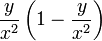 around the point, hence is continuous.
 - At any point on the line
 other than the origin, there are two definitions of the function around the point: the definition 0 (from the
  side), and the definition (from the side). Both definitions evaluate to zero at the point, which is the same as the function value at the point.
 - At any point on the curve
 other than the origin, there are two definitions of the function around the point: the definition 0 (from the
  side), and the definition (from the side). Both definitions evaluate to zero at the point, which is the same as the function value at the point.
We now argue that is continuous in every linear direction at . It suffices to consider half-line directions because continuity from a linear direction is continuity from both half-line directions.
- For the half-line directions that are below or along the line, the function is identically zero along the half-line, so the limit at the origin is zero, which equals the zero.
- For the half-line direction the positive
 -axis, the function is identically zero along the half-line, so the limit at the origin is zero, which equals the zero.
 - For the other half-line directions that are above , we note that, sufficiently close to the origin, this half-line is completely above the curve (explicitly, if the slope of the line is
 , then the half-line is above for
  ). Thus, sufficiently close to the origin, looks like the zero function on this half-line. Thus, the limit at the origin is zero, which equals the value.
We finally demonstrate that is not continuous at by finding a curve approaching the origin along which the limit at the origin is not zero. Consider the curve:

Consider the limit:

Intuitive explanation of example
Intuitively, this example function is zero on a very large subset of the domain, and the set of points where it is nonzero is a narrow squished subset of the plane that, near the origin, is too small to be detected by straight lines.
Generalization to functions of more than two variables
We can use the same example as for a function of two variables, with the above functional form in terms of two of the input variables, and with the function independent of the remaining variables.
Source: https://calculus.subwiki.org/wiki/Continuous_in_every_linear_direction_not_implies_continuous
0 Response to "At What Points in the Plane is the Function Not Continuous"
Post a Comment